
Your trusted guide to authentic Italian cooking
The Complete Guide to Italian Flour Types
Discover which Italian flour to use, why it matters, and how choosing the right flour transforms your pasta, bread, and pizza.
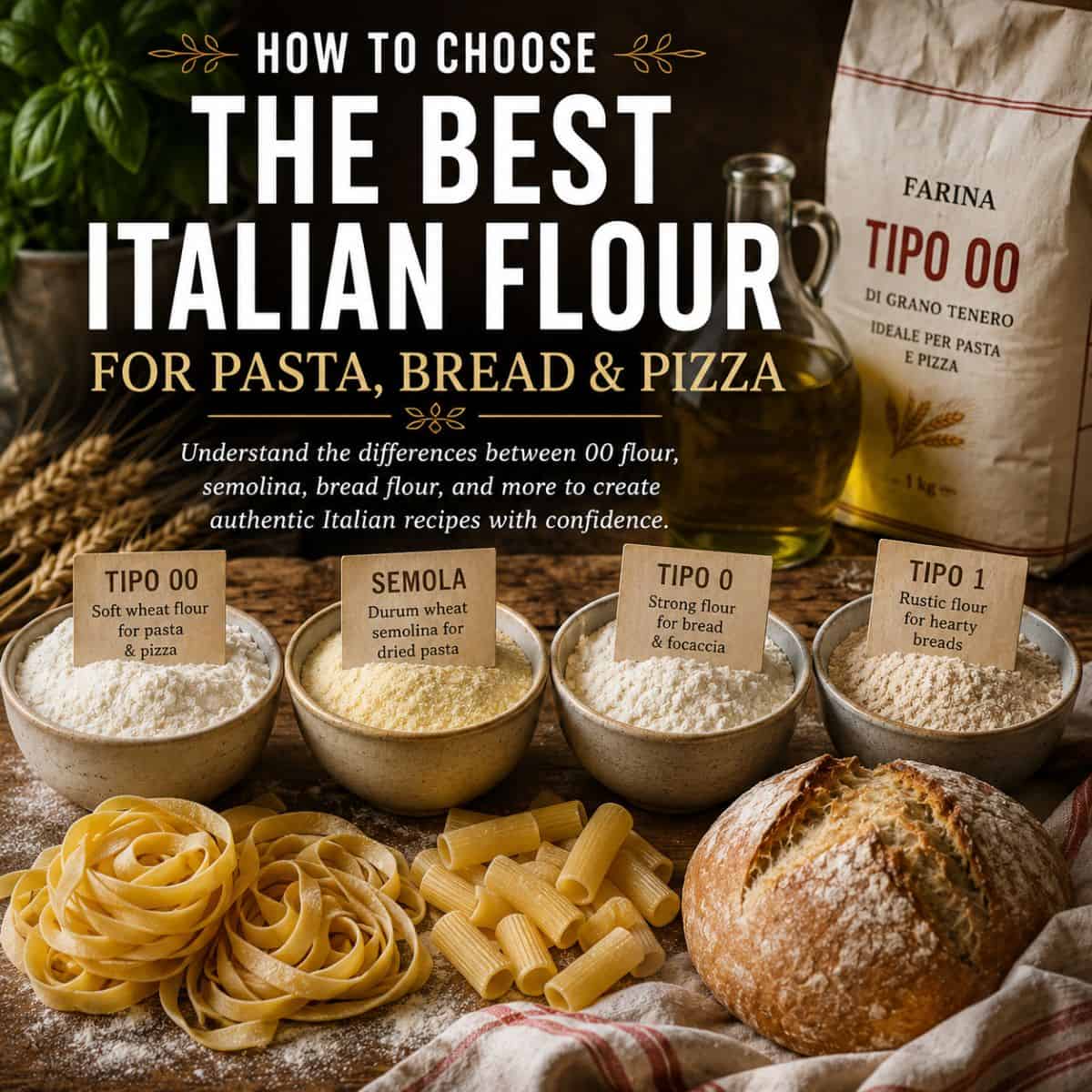
If you're wondering which Italian flour to buy, here's a simple guide:
- Tipo 00 Flour is best for fresh pasta, Neapolitan pizza, and delicate doughs.
- Semola di Grano Duro (Semolina Flour) is ideal for dried pasta and rustic southern Italian breads because it creates a firmer texture.
- Tipo 0 or Bread Flour works best for breads that need strength and long fermentation.
- All-Purpose Flour can produce excellent homemade pasta and bread when Italian flour isn't available.
The best flour isn't the most expensive.
It's the one that matches the recipe.
What You'll Learn
By the end of this lesson, you'll understand:
✓ The differences between Italian flour types
✓ When to use Tipo 00, Semola, Tipo 0, and all-purpose flour
✓ Why protein content changes dough
✓ How flour affects pasta, bread, and pizza
✓ The common flour mistakes that make dough difficult to work with
Which Flour Should You Buy?
Walk into an Italian grocery store and you'll probably see shelves filled with unfamiliar bags of flour.
Tipo 00.
Tipo 0.
Semola.
Manitoba.
Bread flour.
All-purpose.
It's enough to make anyone wonder,
"Do I really need all of these?"
The answer is simple.
No.
You don't need every flour.
You just need the right flour for the job.
Italian cooks don't believe one flour is better than another.
They believe every flour has a purpose.
Some create silky sheets of fresh pasta.
Others produce crusty loaves of bread.
Some stretch beautifully into pizza dough.
Others create the firm bite that makes dried pasta so satisfying.
Choosing flour isn't about buying the fanciest bag on the shelf.
It's about matching the flour to the result you want on your plate.
Once you understand that simple idea, flour stops feeling confusing.
It starts becoming one of your greatest tools.
The Italian Way
Italian cooks don't ask,
"Which flour is the best?"
They ask,
"Which flour is right for this recipe?"
The answer changes with every dough.
A Simple Flour Guide
If you're not sure where to begin, start here.
| If you're making... | Best Flour | Why |
|---|---|---|
| Fresh Egg Pasta | Tipo 00 | Creates smooth, silky dough that's easy to roll. |
| Ravioli & Filled Pasta | Tipo 00 | Produces delicate pasta that seals beautifully. |
| Dried Pasta | Semola di Grano Duro | Holds its shape and develops a firm bite. |
| Neapolitan Pizza | Tipo 00 | Produces a light, airy crust with excellent stretch. |
| Focaccia | Tipo 0 or Bread Flour | Builds strength while remaining tender. |
| Rustic Bread | Tipo 1 or Tipo 2 | Adds flavor, texture, and character. |
| Everyday Homemade Pasta | All-Purpose Flour | A reliable substitute that's easy to find. |
Keep this table in mind whenever you're planning a recipe.
The flour becomes much easier to choose once you know what you're making.
What is TIPO 00 Flour?
One of the biggest misconceptions about Italian flour is that Tipo 00 comes from a special variety of wheat.
It doesn't.
The number simply describes how finely the flour has been milled.
Think of it like sand on a beach.
Some grains are coarse.
Others feel almost like powder.
Tipo 00 is the finest of the traditional Italian milling grades.
That fine texture creates dough that's smooth, soft, and easy to stretch.
It's one of the reasons fresh pasta feels silky and authentic.
It's also why Neapolitan pizza makers have trusted it for generations.
But here's something many people don't realize.
Not every Tipo 00 flour is the same.
Some are made for pizza.
Others are designed for fresh pasta.
Some contain more protein than others.
That's why reading the label is just as important as reading the number on the front of the bag.
Did You Know?
The "00" on the bag doesn't tell you how strong the flour is.
It only tells you how finely it has been milled.
Two different Tipo 00 flours can behave very differently depending on their protein content.
Why Flour Behaves Differently
At first glance, every bag of flour looks almost identical.
They're all soft.
They're all made from wheat.
They're all white or lightly cream colored.
So why does one flour create silky ravioli while another produces a crusty loaf of bread?
The answer lies in two important characteristics:
How finely the flour is milled.
And...
How much protein it contains.
These two qualities determine how a dough feels, stretches, rises, and bakes.
Once you understand them, choosing flour becomes much less intimidating.
Instead of guessing, you'll know exactly what your dough needs.
Did You Know?
Italian flour isn't classified by protein first.
Traditional Italian labels like Tipo 00, Tipo 0, and Tipo 1 describe how finely the flour is milled.
Protein content is a separate measurement and can vary even within the same flour type.
Why Protein Matters
Think of protein as the framework inside your dough.
When flour mixes with water, proteins begin forming gluten.
That gluten creates an elastic network that gives dough its strength.
More protein generally means:
✔ More stretch
✔ Stronger dough
✔ Better rise for bread and pizza
Lower protein creates:
✔ Softer dough
✔ More delicate texture
✔ Tender pasta and pastries
Neither is better.
Each simply serves a different purpose.
That's why the flour for a chewy ciabatta loaf isn't usually the same flour you'd choose for delicate sheets of fresh tagliatelle.
Chef's Tip
Don't get caught chasing the highest protein percentage.
Instead, ask yourself one question:
"What am I making today?"
The answer will almost always guide you toward the right flour.
Choosing Flour For Fresh Pasta
Fresh pasta is all about balance.
The dough should feel smooth, flexible, and easy to roll.
It needs enough strength to hold together while remaining tender after cooking.
That's why many Italian cooks reach for Tipo 00 flour.
Its fine texture creates silky dough that's ideal for:
- Tagliatelle
- Fettuccine
- Ravioli
- Tortellini
- Lasagna sheets
Some recipes combine Tipo 00 with a small amount of semola to add a little extra bite.
Others use only Tipo 00 for exceptionally delicate pasta.
Neither approach is wrong.
Italian cooking is full of regional traditions, and many families proudly make pasta the way their grandparents did.
If you'd like to see how texture affects every pasta dish, continue with How to Cook Perfect Al Dente Pasta.
The Italian Way
Italian cooks don't look for one "perfect" flour.
They build recipes around the strengths of each ingredient.
The flour adapts to the dish, not the other way around.
Choosing Flour For Dried Pasta
Fresh pasta and dried pasta are built for different jobs.
Fresh pasta is soft and delicate.
Dried pasta needs to survive drying, packaging, boiling, and finally finishing in the sauce.
That's why traditional dried pasta is made with semola di grano duro, often called durum wheat semolina.
Semola creates dough that's firmer, stronger, and naturally more resilient.
It holds ridges beautifully.
It keeps its shape during boiling.
Most importantly, it delivers the satisfying bite people expect from authentic Italian dried pasta.
Without that strength, dried pasta would soften too quickly and lose its structure before it ever reached the plate.
Structure begins with the grain itself.
That's one reason so many iconic Southern Italian pasta shapes, from orecchiette to cavatelli, rely on durum wheat.
Did You Know?
Durum wheat is one of the hardest wheat varieties grown.
Its naturally high protein and coarse texture make it ideal for pasta that holds its shape and finishes beautifully in the sauce.
Choosing Flour For Pizza
Not all pizza dough is meant to feel the same.
A classic Neapolitan pizza has a soft, airy crust with a light chew.
Roman-style pizza is crisp and crackly.
Homemade pan pizza is often somewhere in between.
The flour plays a major role in creating those differences.
For traditional Neapolitan pizza, many pizzaioli choose a strong Tipo 00 flour because it stretches easily and supports long fermentation.
For home ovens, bread flour can be an excellent substitute, offering enough strength to produce a chewy, flavorful crust when authentic Italian flour isn't available.
The goal isn't to copy one style.
It's to choose the flour that supports the pizza you're trying to make.
If you're following one of our pizza recipes, we'll always recommend the flour that best matches that specific style.
While Your Doug Rests…
If you're making pasta, let the dough relax before rolling.
If you're baking bread, resist the urge to rush the rise.
If you're preparing pizza, remember that time is just as important as flour.
The best doughs aren't forced.
They're given time to develop.
While your dough rests, consider sharing this guide with someone who's ever stood in the baking aisle wondering,
"Which flour am I supposed to buy?"
Helping another cook choose the right ingredient is often the first step toward helping them create something they'll be proud to serve.
Why Italian Flour Feels Different
If you've ever made pasta or pizza in Italy, you may have noticed something.
The dough feels different.
It's smoother.
More elastic.
Easier to work with.
Many people assume it's because Italian flour is somehow "better."
The truth is more interesting.
Italian flour is carefully matched to its purpose.
Millers select different wheat varieties, milling techniques, and protein levels depending on what the flour is meant to become.
Some flours are designed to stretch into delicate pizza dough.
Others are made to create silky pasta sheets.
Others are intended for crusty artisan breads that ferment slowly over many hours.
In other words, Italian flour isn't one product.
It's a collection of ingredients, each created with a specific goal in mind.
That's why experienced Italian cooks rarely ask,
"What's the best flour?"
They ask,
"What's the best flour for this recipe?"
The Italian Way
Italian cooking begins long before the stove is turned on.
Choosing the right ingredient is often the first cooking decision you'll make.
The better the foundation, the easier every step that follows becomes.
How Geography Shaped Italian Flour
Italy's flour traditions weren't created in a factory.
They were shaped by the land.
In Northern Italy, softer wheat has long supported fresh egg pasta like tagliatelle, tortellini, and lasagna.
These doughs are smooth, tender, and easy to roll into thin sheets.
Travel south, and the landscape changes.
Regions such as Puglia and Sicily have traditionally grown durum wheat, producing the semola flour that gives dried pasta its firm texture and rustic character.
That's why many Southern Italian pasta shapes, including orecchiette and cavatelli, rely on semola rather than soft wheat flour.
The ingredients reflect the climate.
The recipes reflect the ingredients.
Understanding that connection helps explain why Italian cuisine varies so beautifully from one region to another.
If you'd like to explore how geography influences Italian food traditions, continue with Puglia: Where Pasta Meets the Farm.
Did You Know?
Italy's regional cuisines developed around the grains that grew best in each area.
The flour wasn't chosen to fit the recipe.
The recipes evolved from the flour that local farmers harvested.
Can You Substitute Flours?
Absolutely.
And this is where many home cooks gain confidence.
You don't need an Italian specialty shop to make authentic Italian food.
If your grocery store doesn't carry Tipo 00 flour, don't stop cooking.
All-purpose flour can make wonderful fresh pasta.
Bread flour can produce excellent pizza dough.
Semolina flour can often be blended with other flours to create additional structure.
Will every substitution produce identical results?
No.
But Italian cooking has always been about adapting to what's available while respecting the technique.
Learning why a recipe recommends a particular flour is more valuable than memorizing one specific brand.
Knowledge travels farther than ingredients.
Chef's Tip
If you're just beginning your Italian cooking journey, keep three flours in your pantry:
- All-purpose flour
- Tiipo 00 flour
- Semola di Grano Duro
With those three, you'll be able to prepare the vast majority of authentic Italian pasta, bread, and pizza recipes.
Build your pantry gradually as your confidence grows.
Most Common Flour Mistakes (And How to Fix Them)
Even experienced home cooks occasionally choose the wrong flour.
Fortunately, each mistake teaches something valuable.
Mistake: Assuming all white flour behaves the same
Instead: Check both the flour type and its intended use.
Mistake: Buying Tipo 00 for every recipe
Instead: Remember that Tipo 00 describes the grind, not whether it's automatically the best choice.
Mistake: Ignoring protein content
Instead: Match the flour's strength to the dough you're making.
Mistake: Expecting flour alone to solve every problem
Instead: Great dough also depends on hydration, kneading, resting, and fermentation.
Flour is only one part of the equation.
Mistake: Feeling overwhelmed by Italian flour labels
Instead: Start with the recipe you're making.
Once you know the destination, choosing the right flour becomes much simpler.
Remember This
The best flour isn't the one with the fanciest label.
It's the one that helps you create the texture you're looking for.
Purpose always comes before popularity.
Still have questions? Here are the answers home cooks ask most when choosing flour for Italian recipes.
FAQs: How To Choose The Best Italian Flour
Authentic answers for every Italian cooking question.
Tipo 00 is a finely milled Italian flour. The "00" refers to the grind size, not the protein content. It's commonly used for fresh pasta and Neapolitan-style pizza because it creates smooth, elastic dough.
No. While both can be used for many recipes, Tipo 00 is milled much more finely. Some all-purpose flours can be substituted successfully, especially for homemade pasta, but the texture may differ slightly.
Tipo 00 is made from soft wheat and is finely milled, making it ideal for fresh pasta and pizza. Semola is made from durum wheat and has a coarser texture, giving dried pasta its signature firmness and bite.
Yes. Many excellent homemade pasta recipes use all-purpose flour. While Tipo 00 creates an exceptionally smooth dough, all-purpose flour remains a practical and reliable alternative.
It depends on the bread. Strong flours such as Tipo 0 or bread flour work well for long-fermented breads like ciabatta, while rustic loaves may benefit from Tipo 1 or Tipo 2 flour.
Traditional Neapolitan pizza is typically made with a strong Tipo 00 flour that stretches easily and performs well during long fermentation.
Yes. Higher protein creates stronger gluten development, making it ideal for breads and pizza. Lower protein generally produces more tender doughs for pastries and some fresh pastas.
Absolutely. Many Italian recipes blend flours to achieve the perfect balance of tenderness, elasticity, and structure.
The Italian Lesson
One of the quiet strengths of Italian cooking is that it teaches you to understand your ingredients before you try to master your recipes.
Flour is a perfect example.
It may look simple.
Ordinary, even.
Yet inside every bag is the potential for delicate ravioli, rustic bread, airy pizza, or perfectly structured pasta.
Italian cooks don't see flour as interchangeable.
They see it as a building material.
Choose the right foundation, and every step that follows becomes easier.
That's a lesson worth carrying into every recipe you make.
Because great Italian cooking doesn't begin with the oven or the stovetop.
It begins with understanding what you're holding in your hands.
Your Next Lesson Awaits...
Every great Italian cook learns one technique at a time.
Continue building your confidence with these related lessons.
Salt: The Foundation of Italian Flavor
Learn how seasoning shapes every Italian dish and why salt is one of the most important ingredients in your kitchen.
Mastering Italian Pasta: Salt, Sauce & Texture
Discover the five fundamentals that transform ordinary pasta into authentic Italian cooking, from seasoning and texture to sauce integration.
How to Knead Dough Like an Italian Artisan
Master one of the most important skills in bread and pasta making by learning how proper kneading develops strength, elasticity, and structure.
The Importance of Resting Dough
Discover why time is one of the most important ingredients in Italian baking and how resting transforms dough for pasta, bread, and pizza.

JOIN THE ITALIAN KITCHEN
Every great Italian meal begins with curiosity.
Every week you'll discover authentic recipes, practical techniques, ingredient guides, and the traditions behind Italy's greatest dishes.
✓ Cook authentic Italian recipes with confidence
✓ Master techniques used in Italian kitchens
✓ Learn ingredients that make every dish better
✓ Discover the traditions behind every recipe
From our kitchen to yours.
Every lesson at Italian Cooking Ideas is written to help you cook authentic Italian food with confidence, one technique at a time.
Until next time...
We'll see you in the kitchen.
Comments
No Comments