
Your trusted guide to authentic Italian cooking
The Complete Guide to DOP, IGP, Aging & Buying the Right Bottle
Confused by DOP, IGP, aging, and supermarket labels? Learn how to choose authentic Italian balsamic vinegar, understand what you're buying, and use it the Italian way.
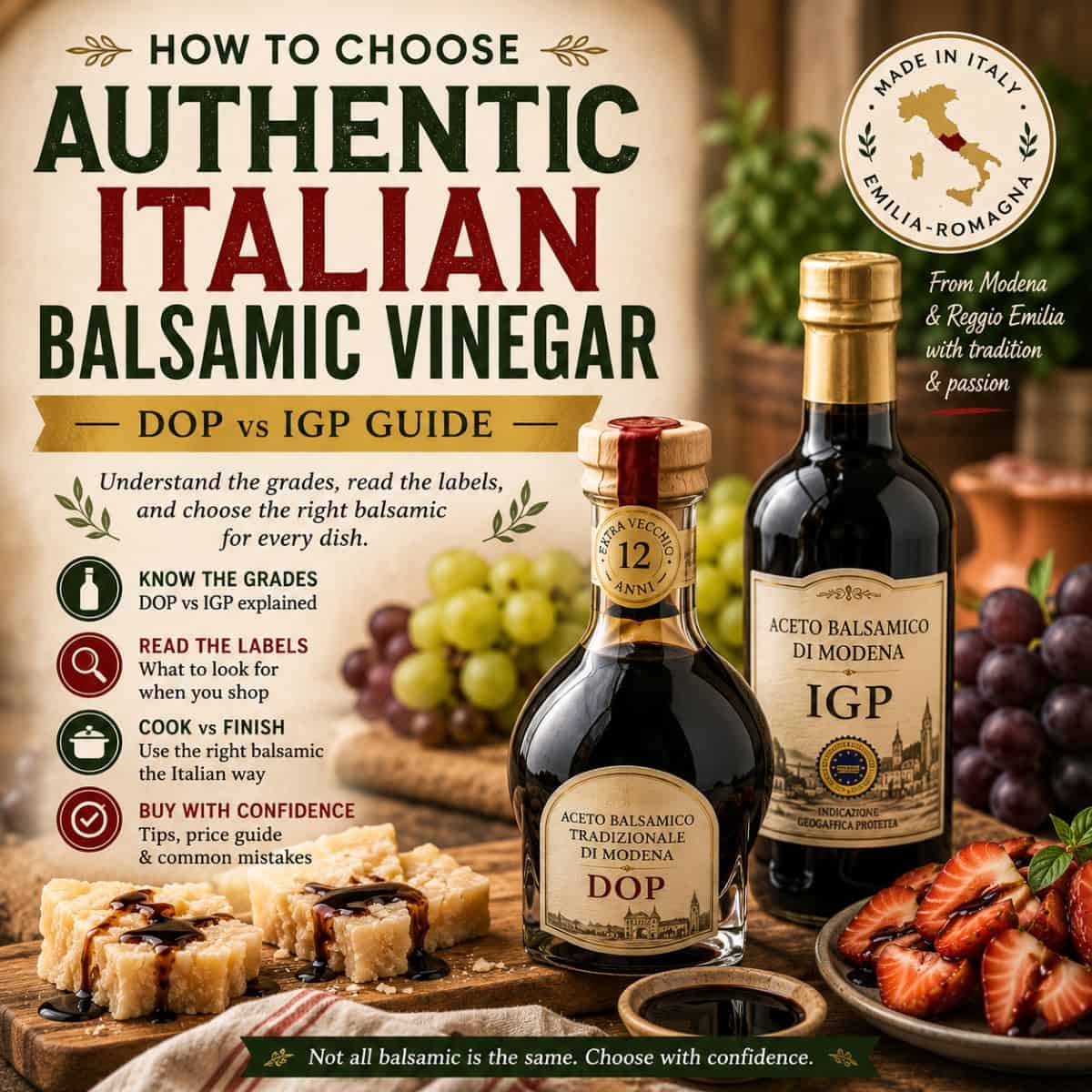
If you're wondering which Italian balsamic vinegar to buy, here's the simple answer:
- Aceto Balsamico Tradizionale DOP is the highest quality. It's aged for at least 12 years, made only from cooked grape must, and used as a finishing ingredient.
- Aceto Balsamico di Modena IGP is more affordable and versatile. It's ideal for salad dressings, marinades, sauces, and everyday cooking.
- If the ingredient list begins with cooked grape must, you're generally looking at a higher quality bottle.
- Don't judge balsamic by thickness or color alone. Authenticity comes from how it's made, not how dark it looks.
The best balsamic vinegar isn't always the most expensive.
It's the one that matches how you plan to use it.
What You'll Learn
By the end of this lesson, you'll understand:
✓ The difference between DOP and IGP balsamic vinegar
✓ Which balsamic vinegar to buy for cooking and finishing
✓ Why aging changes flavor and texture
✓ How to read an authentic Italian label
✓ Common mistakes people make when buying balsamic vinegar
Which Balsamic Vinegar Should You Buy?
Walk down the vinegar aisle and you'll see dozens of bottles claiming to be "balsamic."
Some cost less than ten dollars.
Others are locked behind glass cases.
Some pour like water.
Others drip like syrup.
It's easy to wonder whether they're really the same ingredient.
The answer is no.
Italian balsamic vinegar isn't one product.
It's an entire family of products, each created for a different purpose.
Some bottles are designed for everyday cooking.
Others spend decades aging inside wooden barrels before they're ever opened.
Neither is automatically better.
They simply belong in different places in the kitchen.
Once you understand that difference, buying balsamic vinegar becomes surprisingly simple.
The Italian Way
Italian cooks don't ask,
"Which balsamic is the most expensive?"
They ask,
"Which balsamic belongs in this dish?"
Choosing the right bottle is part of the recipe itself.
A Balsamic Vinegar Buying Guide
If you're standing in the grocery store, use this chart as your guide.
| If you're making... | Buy... | Why |
|---|---|---|
| Salad Dressings | Aceto Balsamico di Modena IGP | Balanced flavor for everyday use |
| Marinades | IGP | Holds up well during cooking |
| Roasted Vegetables | IGP | Adds depth without wasting premium vinegar |
| Balsamic Reduction | IGP | Designed for cooking applications |
| Parmigiano Reggiano | Tradizionale DOP | Complex flavor shines as a finishing touch |
| Fresh Strawberries | Tradizionale DOP | Natural sweetness enhances fruit |
| Grilled Steak | Tradizionale DOP | Adds richness with only a few drops |
| Vanilla Gelato | Tradizionale DOP | A classic Italian pairing |
Most home cooks only need one excellent IGP bottle for everyday cooking.
Save Traditional DOP for the dishes where it can truly shine.
What Makes Authentic Italian Balsamic Different?
One of the biggest misconceptions about balsamic vinegar is that it's simply wine vinegar with caramel coloring.
Authentic Italian balsamic is far more complex.
Traditional balsamic begins with freshly harvested grapes.
Those grapes are slowly cooked into a concentrated grape must before they're transferred into a series of wooden barrels to age.
Over the years, something remarkable happens.
Water slowly evaporates.
Flavors become more concentrated.
Sweetness and acidity gradually come into balance.
The vinegar becomes thicker, smoother, and more aromatic without relying on artificial thickeners or added sugars.
Time does the work.
That's why authentic balsamic tastes layered rather than sharply acidic.
Every drop reflects years of patience.
Did You Know?
Traditional balsamic vinegar isn't primarily made from wine vinegar.
It's made from slowly cooked grape must that's naturally transformed through years of aging.
That surprises many first-time buyers.
DOP VS IGP: What's The Difference?
Once you've started shopping for authentic Italian balsamic vinegar, you'll notice two important abbreviations on the label:
DOP
and
IGP.
These aren't marketing terms.
They're official Italian and European certifications that protect how the vinegar is made and where it comes from.
Understanding the difference is one of the easiest ways to become a more confident shopper.
Aceto Balsamico Tradizionale DOP
This is the highest expression of traditional balsamic vinegar.
Every bottle follows centuries-old production methods that have been carefully protected by Italian law.
Traditional DOP balsamic is made using only one ingredient:
Cooked grape must.
Nothing more.
No wine vinegar.
No caramel coloring.
No thickeners.
No shortcuts.
The vinegar is then aged inside a succession of wooden barrels, each made from different types of wood such as oak, chestnut, cherry, mulberry, or juniper.
As years pass, a small amount evaporates while the remaining vinegar becomes richer, thicker, and more complex.
To earn the DOP designation, it must be aged for at least 12 years.
Many producers continue aging for 25 years or more, creating extraordinary depth of flavor.
This isn't an ingredient you cook with.
It's an ingredient you honor.
Just a few drops can completely transform a finished dish.
Chef's Tip
Think of Traditional DOP balsamic the way you would think about finishing olive oil.
You don't pour it generously.
You use it thoughtfully.
A few drops are often all you need.
Aceto Balsamico di Modena IGP
This is the balsamic vinegar most Italian households use every day.
Unlike Traditional DOP, IGP balsamic blends cooked grape must with wine vinegar, creating a brighter, more versatile vinegar that's ideal for cooking.
Because it isn't aged for decades, it's also much more affordable.
That doesn't make it inferior.
It simply gives it a different role.
IGP balsamic is excellent for:
- Salad dressings
- Marinades
- Roasted vegetables
- Deglazing pans
- Homemade vinaigrettes
- Balsamic reductions
- Everyday Italian cooking
A quality IGP bottle belongs in almost every kitchen.
It's the bottle you'll reach for regularly.
The Italian Way
Italian kitchens often have more than one bottle of balsamic vinegar.
One is used for cooking.
The other is saved for finishing.
Each has a purpose.
Neither replaces the other.
How To Read The Label
One of the easiest ways to avoid buying disappointing balsamic vinegar is to spend thirty seconds reading the label.
Here's what to look for.
Look for DOP or IGP Certification
These protected designations guarantee that the vinegar was produced according to strict regional standards.
If neither appears, the product may simply be balsamic-style vinegar rather than authentic Italian balsamic.
Check the Ingredient List
For Traditional DOP, the ingredient list should contain only:
Cooked grape must.
For IGP, you'll usually see:
• Cooked grape must
• Wine vinegar
Some bottles may include a small amount of caramel coloring, which is permitted in IGP production, but higher-quality bottles often rely less on additives and more on the grapes themselves.
As a general rule, the higher cooked grape must appears on the ingredient list, the richer and more balanced the vinegar tends to be.
Look for the Region
Authentic balsamic vinegar comes from Modena or Reggio Emilia, both located in Italy's Emilia-Romagna region.
These areas have produced balsamic vinegar for centuries.
Their climate, grape varieties, and aging traditions all contribute to the ingredient's distinctive character.
Did You Know?
Many inexpensive bottles imitate the appearance of aged balsamic by adding caramel coloring or thickening agents.
Authentic traditional balsamic becomes naturally thick through years of slow evaporation, not artificial ingredients.
How Much Should You Spend?
One of the most common questions home cooks ask is,
"Is expensive balsamic really worth it?"
The answer depends entirely on how you plan to use it.
Here's a simple guide.
| Budget | What You'll Find | Best For |
|---|---|---|
| $10 to $20 | Quality IGP balsamic | Everyday cooking, dressings, marinades |
| $20 to $40 | Premium IGP balsamic | Cooking plus light finishing |
| $80 to $150 | Traditional DOP (12 years) | Finishing cheese, fruit, grilled meats |
| $150+ | Extra-aged Traditional DOP | Special occasions and tasting experiences |
For most home cooks, a well-made IGP balsamic vinegar offers the best balance of quality, versatility, and value.
If you eventually purchase a bottle of Traditional DOP, think of it less as a cooking ingredient and more as a finishing seasoning, much like aged Parmigiano Reggiano or exceptional extra virgin olive oil.
Remember This
Don't buy balsamic based on the bottle.
Buy it based on how you'll use it.
The right bottle isn't the most expensive one.
It's the one that belongs in your recipe.
Why Modena Is The Home Of Balsamic Vinegar
Some Italian ingredients can be made almost anywhere.
Authentic balsamic vinegar isn't one of them.
For centuries, the cities of Modena and Reggio Emilia, in Italy's Emilia-Romagna region, have been the heart of traditional balsamic production.
The area provides an ideal combination of climate, seasonal temperatures, and local grape varieties that allow balsamic vinegar to mature slowly over many years.
Warm summers encourage evaporation.
Cold winters allow the vinegar to rest.
That natural cycle repeats year after year, gradually concentrating the vinegar and developing remarkable depth of flavor.
Just as Champagne can only come from Champagne, France, authentic Traditional Balsamic Vinegar comes only from these historic Italian regions.
Place matters.
Time matters.
Tradition matters.
If you'd like to discover why Emilia-Romagna has become one of Italy's greatest food regions, continue with Emilia-Romagna: Birthplace of Italy's Best Ingredients.
The Italian Way
Italian ingredients are deeply connected to where they're produced.
When Italians protect a region, they're protecting generations of craftsmanship, tradition, and knowledge.
How Aging Creates Extraordinary Flavors
One of the most fascinating parts of traditional balsamic production happens long after the grapes have been harvested.
The vinegar is transferred into a series of progressively smaller wooden barrels.
Each barrel is made from a different type of wood.
Oak.
Cherry.
Chestnut.
Mulberry.
Juniper.
Every wood contributes its own subtle character over time.
As the vinegar slowly evaporates, its flavors become more concentrated.
Its acidity softens.
Its sweetness becomes richer.
Its aroma grows increasingly complex.
No one rushes the process.
No one adds artificial thickeners.
Nature and patience do all the work.
That's why authentic Traditional DOP balsamic develops its signature silky texture naturally.
Time becomes an ingredient.
Did You Know?
Every year, a small amount of vinegar is transferred from one barrel to the next in a traditional aging system called the batteria.
Some barrels have been used by the same families for generations, quietly passing their character from one batch to the next.
Cooking vs Finishing: Know The Difference
Not every balsamic vinegar belongs in a hot pan.
Understanding when to cook with balsamic and when to finish a dish is one of the easiest ways to improve your Italian cooking.
Use IGP Balsamic for Cooking
Aceto Balsamico di Modena IGP is ideal for recipes that involve heat.
Use it for:
- Homemade vinaigrettes
- Pan sauces
- Roasted vegetables
- Marinades
- Balsamic reductions
- Braised meats
Heating allows its bright acidity to mellow while adding depth to the dish.
Use Traditional DOP for Finishing
Traditional balsamic should rarely be cooked.
Instead, use it after the dish has left the heat.
A few drops are all it takes to elevate:
- Parmigiano Reggiano
- Fresh strawberries
- Grilled steak
- Roasted asparagus
- Risotto
- Vanilla gelato
- Caprese salad
Heat would mask many of the delicate aromas that took years to develop.
Finishing preserves their beauty.
Chef's Tip
If you've invested in a bottle of Traditional DOP balsamic, think of it as a finishing spice rather than a cooking ingredient.
The goal isn't to taste a lot of balsamic.
The goal is to notice how a few drops transform everything else.
Most Common Balsamic Mistakes (And How to Fix Them)
Choosing authentic balsamic becomes much easier once you know what to avoid.
Mistake: Assuming darker vinegar is always better.
Why it happens: Many inexpensive products use caramel coloring to create a darker appearance.
How to fix it: Read the ingredient list before judging the color.
Mistake: Buying the most expensive bottle for everyday cooking.
Why it happens: Higher price is often mistaken for greater versatility.
How to fix it: Save Traditional DOP for finishing. Use quality IGP for cooking.
Mistake: Reducing premium traditional balsamic.
Why it happens: Many people assume every balsamic should be cooked.
How to fix it: Reserve reductions for IGP balsamic. Let Traditional DOP shine on finished dishes.
Mistake: Ignoring the certification.
Why it happens: The labels can seem confusing.
How to fix it: Look for DOP or IGP certification and understand what each represents.
Mistake: Pouring too much.
Why it happens: It's treated like ordinary vinegar.
How to fix it: Authentic balsamic is meant to complement the dish, not dominate it.
Remember This
The best balsamic vinegar isn't defined by how thick it is.
It's defined by how thoughtfully it's made and how thoughtfully it's used.
A few well-placed drops can do more than an entire pour.
Still have questions? Here are the answers home cooks ask most when shopping for and using authentic Italian balsamic vinegar.
FAQs: How To Choose Authentic Italian Balsamic Vinegar
Authentic answers for every Italian cooking question.
Traditional DOP balsamic is made only from cooked grape must and aged for at least 12 years under strict regulations. IGP balsamic blends cooked grape must with wine vinegar, making it more versatile and affordable for everyday cooking.
If you're looking for an everyday bottle for cooking, dressings, and marinades, choose a quality Aceto Balsamico di Modena IGP. If you want an exceptional finishing vinegar for cheese, fruit, or grilled meats, invest in a Traditional DOP bottle.
Yes, but only if you'll use it as intended. Traditional DOP balsamic offers extraordinary complexity that shines as a finishing ingredient. It's generally not economical or necessary for everyday cooking.
It's possible, but it's not recommended. Heat can diminish the delicate aromas developed through years of aging. Traditional balsamic is best enjoyed after the dish is finished.
No. Balsamic glaze is typically a reduced or thickened product that often contains added sweeteners or stabilizers. Authentic balsamic vinegar develops its texture naturally through aging.
No. Store balsamic vinegar in a cool, dark place with the bottle tightly sealed. Refrigeration isn't necessary and may dull some of its aromas.
Authentic balsamic vinegar has an exceptionally long shelf life because of its acidity. While its flavor may slowly change after opening, it generally remains safe and enjoyable for many years when stored properly.
The Italian Lesson
One of the easiest ways to recognize authentic Italian cooking is to notice how carefully each ingredient is treated.
Balsamic vinegar is a perfect example.
It isn't added simply because it's available.
It's chosen because it belongs.
A few drops over aged cheese.
A finishing touch on grilled vegetables.
A quiet accent that brings every other flavor into harmony.
Italian cooking isn't about using more.
It's about using the right ingredient, at the right time, in the right amount.
That's why authentic balsamic vinegar isn't remembered for its sharpness.
It's remembered for its balance.
Your Next Lesson Awaits...
Every great Italian cook learns one technique at a time.
Continue building your confidence with these related lessons.
Olive Oil: Cold-Pressed vs Extra Virgin
Learn how to choose authentic Italian olive oil and understand when to cook with it or finish a dish.
How to Choose the Best Italian Flour for Pasta, Bread & Pizza
Discover the differences between Tipo 00, semola, and bread flour so you can confidently choose the right flour for every recipe.
Salt: The Foundation of Italian Flavor
Explore how seasoning shapes every Italian dish and why balance matters more than simply adding salt.
The Cheeses of Italy: Region by Region
Travel across Italy through its iconic cheeses and learn which regions produce some of the country's most celebrated flavors.

JOIN THE ITALIAN KITCHEN
Every great Italian meal begins with curiosity.
Every week you'll discover authentic recipes, practical techniques, ingredient guides, and the traditions behind Italy's greatest dishes.
✓ Cook authentic Italian recipes with confidence
✓ Master techniques used in Italian kitchens
✓ Learn ingredients that make every dish better
✓ Discover the traditions behind every recipe
From our kitchen to yours.
Every lesson at Italian Cooking Ideas is written to help you cook authentic Italian food with confidence, one technique at a time.
Until next time...
We'll see you in the kitchen.
Comments
No Comments