
Your trusted guide to authentic Italian cooking
How one simple step transforms the flavor of every pasta dish.
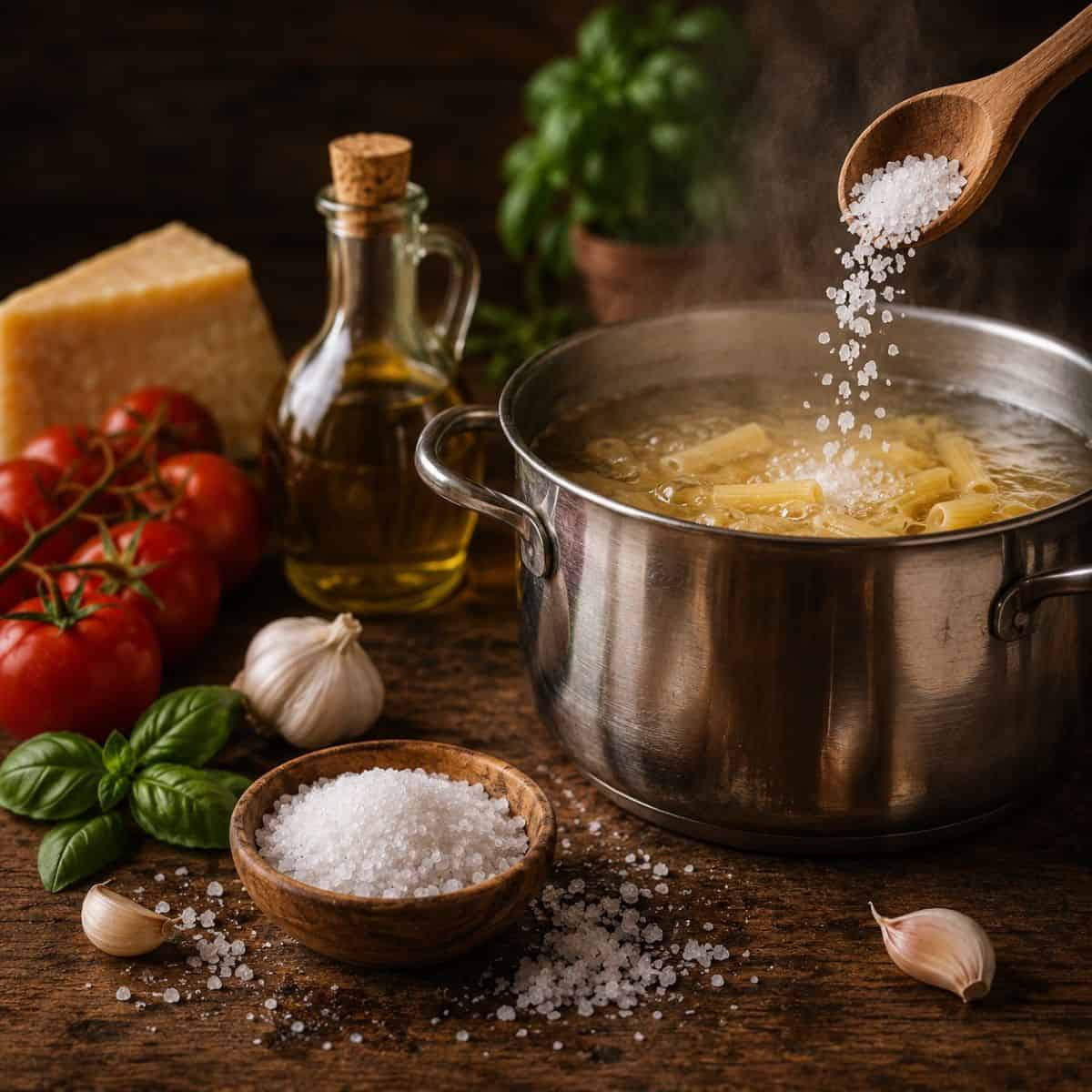
If you're wondering how to salt pasta water the Italian way, wait until the water reaches a full rolling boil before adding the salt. The water should taste pleasantly seasoned, similar to a light broth. Add the pasta only after the salt has completely dissolved. Properly seasoned water allows the pasta itself to develop flavor, creating a balanced dish before the sauce is ever added.
What You'll Learn
By the end of this lesson, you'll understand:
✔ Why Italians always season pasta water
✔ How much salt pasta water actually needs
✔ When to add the salt for the best results
✔ Why properly seasoned pasta tastes better than relying on the sauce alone
✔ The simple habit that instantly improves almost every pasta dish
Flavor Begins Before the Sauce
Ask someone what makes great pasta and they'll usually mention the sauce.
A rich ragù.
Fresh basil.
Parmigiano Reggiano.
Perfectly cooked tomatoes.
Ask an Italian cook the same question and you may hear something different.
Before the tomatoes simmer.
Before the cheese is grated.
Before olive oil finishes the plate.
One quiet decision has already been made.
Was the pasta water seasoned properly?
It seems like a small detail, but it changes every bite that follows.
As pasta cooks, it absorbs the water surrounding it. When that water is properly seasoned, the pasta develops flavor from the inside out. When it isn't, the noodles remain bland, forcing the sauce to work much harder than it should.
That's one of the biggest differences between simply making pasta and cooking pasta the Italian way.
Italian cooking has never been about fixing flavor at the end.
It's about building flavor from the very beginning.
If you've read our lesson on Mastering Italian Pasta: Salt, Sauce & Texture, you've already seen how every stage of cooking contributes to the finished dish. Salting the water is one of the very first building blocks.
Did You Know?
One of the biggest myths about pasta is that all of the salt ends up in your dinner.
It doesn't.
Most of the salt remains in the pot after the pasta is drained.
The pasta absorbs only a small amount while it cooks, which is exactly why properly seasoned water creates balanced flavor without making the finished dish taste overly salty.
Why Pasta Water Must Be Seasoned
Pasta is not simply a vehicle for sauce.
It is one of the main ingredients on the plate.
It deserves to taste good on its own.
When pasta cooks in properly seasoned water, a small amount of salt is absorbed into the noodle itself. That seasoning becomes part of the pasta rather than sitting on the surface.
The result is subtle but unmistakable.
The pasta tastes complete before the sauce is even added.
Without seasoned water:
- Pasta tastes flat.
- Sauces must compensate with extra seasoning.
- Cheese becomes responsible for adding flavor instead of enhancing it.
- The finished dish feels unbalanced.
Italian cooking avoids these problems by seasoning early instead of correcting later.
That idea appears again and again throughout Italian cuisine.
A patient soffritto.
Properly salted pasta water.
Good olive oil.
Fresh ingredients.
None of these decisions seem dramatic on their own.
Together, they create extraordinary food.
As you'll discover in our lesson on Salt: The Foundation of Italian Flavor, seasoning isn't about making food salty. It's about allowing every ingredient to become more fully itself.
Why This Matters
Many home cooks ask whether salting pasta water is really necessary.
In Italy, that question rarely comes up.
Seasoning the water isn't viewed as an optional trick.
It's simply part of cooking pasta correctly.
Why?
Because every ingredient has a responsibility.
The pasta should taste good.
The sauce should taste good.
The cheese should taste good.
No single ingredient should carry the entire dish.
When each component contributes its own flavor, the final plate feels balanced, lighter, and far more satisfying.
This is one of the quiet philosophies that runs through Italian cooking.
Great meals aren't created by one spectacular ingredient.
How Much Salt Is Correct?
This is probably the question that brought you here.
The honest answer is that there isn't one perfect tablespoon measurement.
Different pots hold different amounts of water.
Different brands of salt vary in crystal size.
Experienced Italian cooks rarely measure with precision.
Instead, they trust their palate.
The cooking water should taste pleasantly seasoned, much like a light broth.
Not aggressively salty.
Not bland.
Just enough that you immediately notice the seasoning without wanting to stop tasting it.
This often surprises new cooks because most of the salt never reaches your plate.
The majority stays behind in the cooking water.
The pasta absorbs only what it needs to build balanced flavor naturally.
Confidence matters more than memorizing numbers.
Learning to taste the water is one of the first signs you're beginning to cook with instinct instead of simply following instructions.
When Should You Add the Salt?
Timing matters almost as much as quantity.
Always bring the water to a full rolling boil first.
Then add the salt.
Allow it to dissolve completely before adding the pasta.
This helps distribute the seasoning evenly throughout the pot and ensures every piece of pasta begins cooking under the same conditions.
Small moments like these are easy to overlook.
Yet they're exactly the kind of details that separate consistent cooks from frustrated ones.
Italian cooking isn't built on secret ingredients.
It's built on paying attention to the little things.
Chef's Tip
Use coarse kosher salt or coarse sea salt whenever possible.
The larger crystals are easier to control than fine table salt, making it less likely you'll accidentally over-season the water.
Whatever salt you choose, trust your taste buds more than your measuring spoo
While Your Pasta Cooks…
Go give your pasta a quick stir.
If it's been cooking for a few minutes, fish out a piece and take a bite. You're looking for a little resistance in the center, not a completely soft noodle.
Dinner comes first.
We'll save your seat.
And if this lesson has already answered a question you've wondered about before, now's a great time to share it with a friend or family member who loves Italian food.
Some of the best kitchen traditions begin with someone saying,
"You should see how the Italians do this."
The Relationship Between Pasta and Sauce
Once your pasta is properly seasoned, something interesting happens.
The sauce no longer has to rescue the dish.
Instead, it gets to complement it.
That's an important distinction.
Many home cooks unknowingly ask too much of their sauce. They expect it to provide all the seasoning, all the richness, and all the personality.
Italian cooking spreads those responsibilities across every ingredient.
The pasta contributes flavor.
The sauce contributes flavor.
The cheese contributes flavor.
The herbs contribute freshness.
When every component plays its part, nothing has to shout.
That's what balance tastes like.
This is also why Italians almost always finish pasta inside the sauce rather than spooning sauce over plain noodles. As the pasta cooks for its final minute in the pan, starch from the noodles combines with the sauce, creating a silky coating that clings to every bite.
If you've never tried this technique before, our guide to The Best Way to Finish Pasta "in the Sauce" walks through exactly why this simple step transforms the final dish.
Why Restaurant Pasta Tastes Better
One of the most common questions home cooks ask is,
"Why does restaurant pasta always taste better than mine?"
Most people assume chefs use expensive ingredients or secret recipes.
The truth is much simpler.
Restaurants rarely rely on secrets.
They rely on consistency.
Professional kitchens season pasta water confidently.
They taste constantly.
They adjust throughout cooking.
They finish pasta inside the sauce.
They understand that flavor begins long before the food reaches the plate.
Those habits don't require years of culinary school.
They require attention.
Once you begin practicing the same fundamentals at home, you'll notice something surprising.
Your cooking starts tasting more "Italian," even when you're making the same recipes you've always made.
That's because Italian cooking has never been about making dramatic changes.
It's about making small, thoughtful decisions over and over again.
Did You Know?
Many professional Italian kitchens taste pasta before it ever touches the sauce.
Why?
Because if the pasta doesn't taste good on its own, the finished dish never will.
The sauce isn't there to hide mistakes.
It's there to complete the meal.
Texture Is Flavor's Partner
Seasoning isn't the only thing happening inside your pot.
Texture is developing too.
Perfectly seasoned pasta can still disappoint if it's overcooked.
Likewise, perfectly cooked pasta can still feel bland if the water wasn't seasoned properly.
The two work together.
Flavor and texture are partners.
Neither reaches its full potential without the other.
That's why Italian cooks pay close attention to timing.
They don't simply watch the clock.
They taste.
They observe.
They adjust.
Cooking with your senses is one of the biggest steps toward cooking with confidence.
If you'd like to understand why texture matters so much, continue with our lesson on The Science of Perfect Pasta Texture, where we explore what al dente really means and why it has become one of the defining characteristics of authentic Italian pasta.
Common Mistakes (And How to Fix Them)
Mistake: Using Too Little Salt
Why it happens: Fear of making the pasta too salty.
How to fix it: Taste the cooking water. It should taste pleasantly seasoned, like a light broth. Remember that most of the salt stays in the water.
Mistake: Salting the Water Too Early
Why it happens: Adding salt before the water reaches a boil.
How to fix it: Wait until the water reaches a rolling boil, then add the salt. Allow it to dissolve completely before adding the pasta.
Mistake: Trying to Fix Bland Pasta with the Sauce
Why it happens: Assuming the sauce can compensate.
How to fix it: Build flavor into the pasta itself. A properly seasoned noodle allows the sauce to support rather than rescue the dish.
Mistake: Never Tasting the Water
Why it happens: Following measurements without checking the result.
How to fix it: Develop confidence by tasting the water. Your palate is a better guide than any measuring spoon.
Mistake: Forgetting Salty Ingredients
Why it happens: Not considering Parmigiano Reggiano, Pecorino Romano, olives, anchovies, or cured meats.
How to fix it: Think about the entire dish before adjusting seasoning. Every ingredient contributes to the final balance.
Remember This
The best pasta isn't rescued by the sauce.
It arrives at the sauce already full of flavor.
Still curious? Let's answer the questions home cooks ask most, along with a few they often don't think to ask until they're standing in the kitchen.
FAQs: How to Salt Pasta Water
Authentic answers for every Italian cooking question.
Pasta water should be generously seasoned after it reaches a rolling boil and before the pasta is added. The water should taste pleasantly seasoned, similar to a light broth, rather than overwhelmingly salty. Properly salted water seasons the pasta from within, creating balanced flavor that no sauce can fully replace.
Because seasoning the water allows the pasta itself to develop flavor before it is combined with the sauce.
Rather than memorizing an exact measurement, taste the water before adding the pasta. It should taste pleasantly seasoned, similar to a light broth. Different pots, different salts, and different pasta shapes all affect the ideal amount.
You've probably heard this advice before. It's memorable, but it's often misunderstood.
Your pasta water shouldn't taste overwhelmingly salty. Instead, aim for water that's well seasoned and pleasant to taste. Think of a flavorful broth rather than ocean water.
Always wait until the water reaches a rolling boil.
Add the salt.
Allow it to dissolve completely.
Then add the pasta.
This creates even seasoning from the very beginning of cooking.
You can, but you'll notice the difference.
Bland pasta is difficult to rescue later because the sauce has to compensate for flavor the noodles never developed in the first place.
No. Adding salt has very little effect on cooking time.
Its purpose is flavor, not speed.
Yes. Over-seasoned water can overpower delicate sauces, seafood, and lighter pasta dishes. Balance is always the goal.
If you're unsure, taste the water before adding the pasta.
One of the most common reasons is under-seasoned cooking water.
Another is finishing the pasta separately from the sauce instead of allowing them to come together in the pan. Fortunately, both are simple habits to improve.
Restaurants succeed because they consistently execute the fundamentals.
They season confidently.
Taste frequently.
Cook pasta to the correct texture.
Finish it in the sauce.
None of these techniques are complicated, but together they create a noticeable difference.
No. Most of the salt remains in the cooking water. The pasta absorbs only a small amount during cooking.
Absolutely. Fresh pasta cooks much faster than dried pasta, but it still benefits from properly seasoned cooking water.
Flavor begins with the noodle regardless of whether it's fresh or dried.
Yes. Both work well. Just remember that different salts have different crystal sizes, so measurements aren't always interchangeable.
Your taste buds remain your best guide.
Finishing pasta in the sauce allows starch, seasoning, fat, and acidity to combine into one cohesive dish rather than remaining separate components.
No. Despite the myth, olive oil doesn't prevent pasta from sticking.
Instead, stir the pasta during its first minute of cooking. That's the most effective way to keep the noodles separate.
Don't panic. Finish the pasta in the sauce and season the sauce thoughtfully.
The final dish can still be delicious, although you'll notice the noodles won't have quite the same depth of flavor.
The best lesson is simply to remember the salt next time.
Italian cooking is about building habits, not chasing perfection.
The Italian Lesson
One of the biggest misconceptions about Italian cooking is that extraordinary meals depend on extraordinary ingredients.
In reality, they depend on ordinary ingredients treated with extraordinary care.
A properly seasoned pot of water.
Fresh olive oil.
A patient soffritto.
A handful of Parmigiano Reggiano.
None of these things are dramatic.
Yet together they create meals people remember.
That's why salting pasta water is about much more than seasoning.
It's about learning to notice the small decisions that quietly shape every dish.
Once you begin paying attention to those moments, you stop following recipes.
You begin understanding them.
That's where confidence grows.
And that's where authentic Italian cooking truly begins.
Continue Learning
Now that you've mastered one of the most important foundations of Italian pasta, continue building your confidence with these lessons:
Salt: The Foundation of Italian Flavor
Discover why seasoning is about balance rather than making food taste salty, and learn how Italian cooks build flavor layer by layer.
Mastering Italian Pasta: Salt, Sauce & Texture
Learn how timing, starch, sauce, and texture work together to create authentic Italian pasta from start to finish.
How to Balance Salt, Fat & Acid Like an Italian Chef
Take the next step by learning how Italian cooks create harmony between seasoning, richness, and brightness in every dish.

JOIN THE ITALIAN KITCHEN
Every great Italian meal begins with curiosity.
Every week you'll discover authentic recipes, practical techniques, ingredient guides, and the traditions behind Italy's greatest dishes.
✓ Cook authentic Italian recipes with confidence
✓ Master techniques used in Italian kitchens
✓ Learn ingredients that make every dish better
✓ Discover the traditions behind every recipe
From our kitchen to yours.
Every lesson at Italian Cooking Ideas is written to help you cook authentic Italian food with confidence, one technique at a time.
Until next time...
We'll see you in the kitchen.

Comments
No Comments